We have very good links with the Psychology Department at Lancaster University. Throughout the year, there are opportunities to take part in research taking place in their labs which may be of interest and relevance to members of our u3a. In return, PhD students come and talk to us about their findings.
If you want to take part in any of these research projects, please contact the relevant researcher whose email is attached to each item.
Please note: links to email addresses on this page will only open in your browser if you have set up your email provider within your browser settings. If you have not done this then you need to copy the text of the address and paste it directly in your email window once you have opened your account.
Nottingham University is also asking for help...
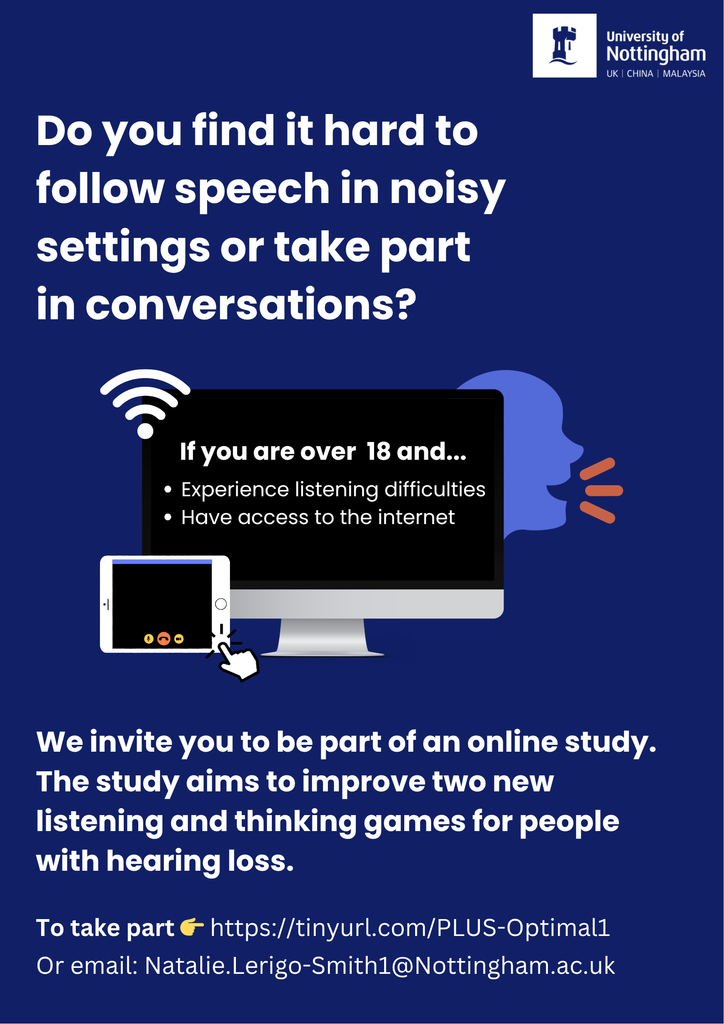
Study Title: PLUS-Optimal for Adults with Listening Difficulties: Investigating the Roles of Listening and Thinking Skills in Online Training Across Different Groups. For more details, please click here.
A new Research Project: Do you struggle to follow conversations in noisy environments?
Researchers at Lancaster University are looking for older adults (60-85 years old) to take part in our current project. You must be a fluent English speaker, without any neurological, psychiatric or language disorders. You must also not have any implanted non-removable metal near your head.
- We will provide you with hearing aids, which you can keep even after your participation in the study has ended
- We will measure your brain activity, thinking and listening skills with these hearing aids
- We will study whether brain stimulation can improve the benefits of hearing aids for older adults
If you are interested in learning more about your hearing and brain health, please contact Dr Jess Pepper for more information about taking part: j.l.pepper@lancaster.ac.uk Thank you!
Research Project 1: Have you recently received hearing aids?
Researchers at Lancaster University are looking for older adults (60-85 years old), who have received their hearing aids within the past 3 months to take part in our current project. You must be a fluent English speaker, without any neurological, psychiatric or language disorders. You must also not have any implanted non-removable metal near your head. Recruitment is ongoing, so if you are fitted with hearing aids in the near future, please get in touch if you are interested in participating.
- Our research aims to find out whether we can boost brain activity so that adapting to hearing aids is faster and more effective.
- We will use brain stimulation to increase brain activity in people who have recently received hearing aids.
- We will use brain scans to understand how brain structure and function have been affected by the brain stimulation. We will use computer tasks to record people's ability to hear and recognise speech after the brain stimulation.
- We will also study whether brain stimulation has provided wider benefits, such as improvements in thinking skills and mental wellbeing.
If you have recently received hearing aids and are interested in taking part, please email Dr Jess Pepper for more information: j.l.pepper@lancaster.ac.uk
Research Project 2: Sport, Sound, and the Brain: Do Contact Sports Leave a Lasting Impact?
Research volunteers needed – adults aged 60–80.
My name is Jessica Andrew and I am a PhD researcher at Lancaster University. I am running a study called “Sport, Sound, and the Brain: Do Contact Sports Leave a Lasting Impact?” looking at how playing contact sports might affect how the brain processes sound as people get older.
I am looking for volunteers aged 60–80, both men and women, who either:
- have regularly played contact sports in the past (for example, rugby or football), or
- have never played contact sports.
Taking part involves one visit to Lancaster University (around 3 hours) for simple listening tasks while we measure brain responses, plus wearing a small pedometer for one week afterwards. Participants will be paid £30 in shopping vouchers for their time, as a thank you.
If you might be interested or would like to find out more, please contact Jessica Andrew at: j.r.andrew@lancaster.ac.uk
Research Project 3: Do you have hearing aids?
Researchers at Lancaster University are looking for older adults (60-84 years old), who have had hearing aids for a minimum of 6-months. To take part in our current project, you must be a fluent English speaker without severe/profound tinnitus and/or a history or diagnosis of cognitive impairment, neurological conditions, coronary heart disease, stroke/transient ischaemic attack and/or take statins.
- Our research aims to understand if cardiovascular health impacts neural and behavioural responses to hearing aids
- We will record brain activity in response to speech sounds with and without hearing aids
- We will measure the accuracy of speech perception with and without hearing aids
- We will measure cardiovascular health by monitoring blood pressure, taking a finger prick blood sample, taking measurements of height and weight, and asking participants to complete a questionnaire about potential risk factors of cardiovascular disease.
If you have hearing aids and are interested in taking part, please email Nez Sharp for more information: n.sharp@lancaster.ac.uk
Research Project 4: Over 60s Strength App Trial
Volunteers are needed for a Lanarkshire PhD student working in conjunction with Lancaster University testing a new app aimed at older people completing at home equipment free exercise. The whole trial can take place in your own home. For more details, click here.
Research Project 5: Exploring how people identify Fake and True news items on social media.
Two Psychology PhD students are inviting participants for their separate projects - which can take place in the same session.
One research project aims to explore how people identify Fake and True news items on social media. This research will inform the development of interventions to support misinformation detection to reduce instances of deception online.
The other research project aims to explore how individuals engage with QR codes. This research is important because QR codes are commonly used in various settings and understanding how people interact with these scannable barcodes can have implications for our security.
If you interested in taking part you are completely free to decide whether you would like to take part in both studies or just one of our studies. If you choose to do both studies, we will arrange for you to take part in the studies on the same day. Each in-person study should take approximately 60 minutes to complete, and you will receive a £15 Amazon Voucher for taking part.
If you would like to take part in any of these studies, please click this link to register your interest: Lancaster Uni PhD Research
Or if you prefer, email Ellie at e.k.ball@lancaster.ac.uk or Holly at FakeNewsDetectionProject@lancaster.ac.uk expressing your interest in taking part. Detailed information will be given.
The eligibility criteria for both studies:
• Participants must be at least 50 years of age
• Participants MUST have normal or corrected-to-normal vision (e.g. you can see clearly when wearing glasses or contact lenses.)
• Participants MUST NOT have any age-related visual impairments (for example glaucoma, cataracts, macular degeneration)
• Participants must be able to travel to the Lancaster University Campus.
Research Project 6: Exploring how Language can Improve how we Age
Are you interested in joining a research project investigating how language can improve how we age? Please email us at babel@lancaster.ac.uk to sign up.
We are currently looking for cognitively healthy older adult participants (anyone 40+) who have at least some knowledge of two or more languages. Thus, whether you have once studied an additional language (or many), even if long ago, irrespective of whether you currently use it/them or not, or if you are a native balanced multilingual from birth or your experience with more than one language exists at any degree or level between these inflection points, we WANT YOU for this study!
A few hours of your time will earn you a £50 Amazon gift card and help us understand how learning and knowing multiple languages might benefit how we age cognitively.
The experiment consists of two sessions:
- Interview (approx. 1 hour): Participants will answer questionnaires about lifestyle and language background over the phone / online (you choose what suits best for you).
- Lab session (approx. 2-3 hour): Participants will complete two computer tasks while we measure brain activity using EEG (a safe, painless method that involves wearing a cap with electrodes). The participants can either come to Lancaster University or we can bring our EEG setup to yours, whatever is most convenient!